How the Subcontinental Giants are shaking, and shaping, the Commodity Tree
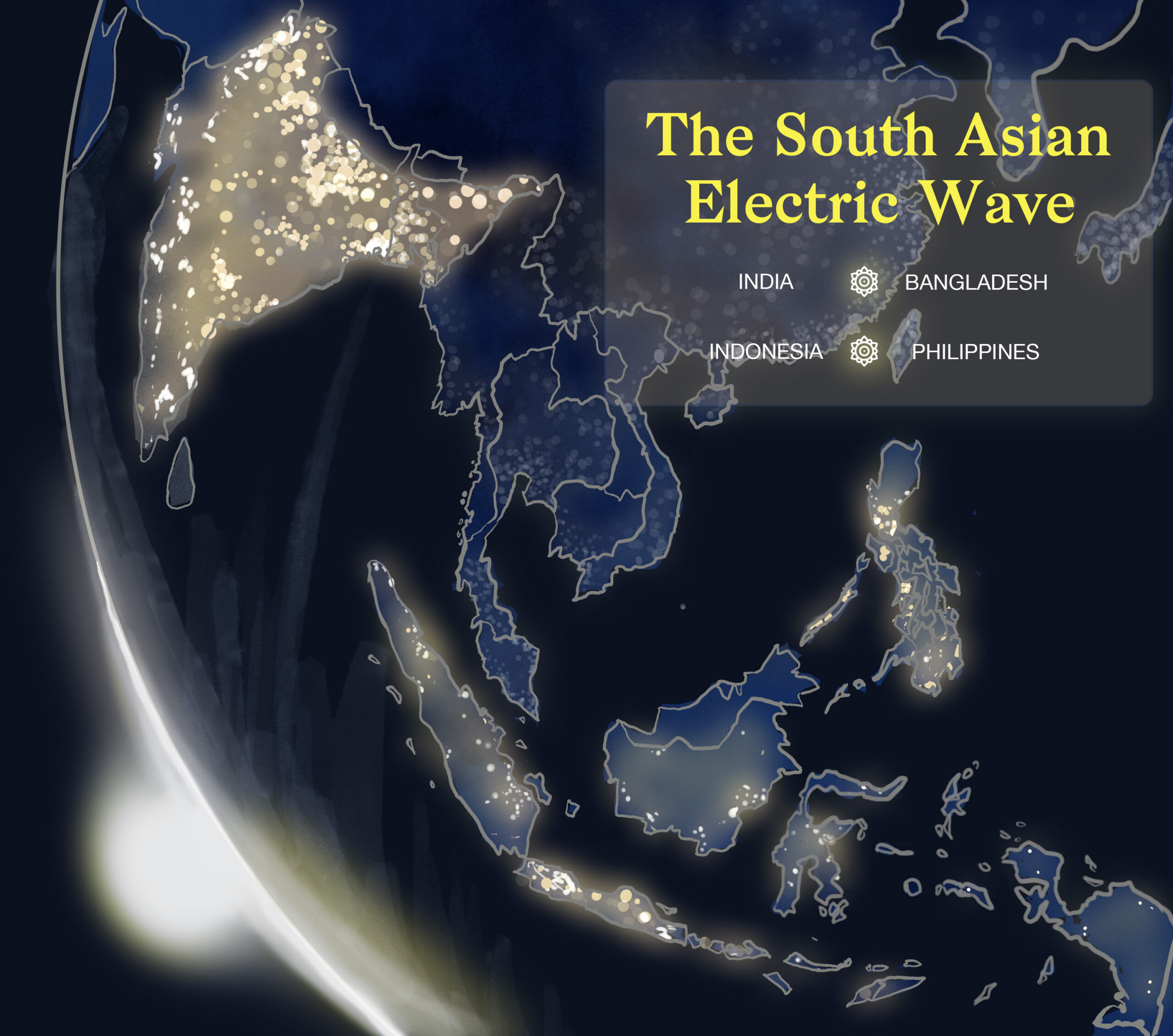
Building on our previous review on the South Asian Electric Wave, the following article explores the creeping influence of two rising South Asian giants -India, and its economically intertwined shadow-sister, Bangladesh- on global commodity markets.
As will be illustrated in this piece, even before the 2020s reached their midpoint, the economic awakening of the Subcontinent had already begun to exert pressure on commodity markets.
Against this backdrop, the sharp price movements across many commodities in the first half of the 2020s should not be brushed aside as quirks or blips; rather, they marked the opening notes of a far louder and much longer symphony that was yet to play.
The weight of evidence points to South Asia’s rise as the decisive factor behind this emerging commodity regime, its orogenic upward ascent triggering shockwaves across global markets even before the decade had called half-time.
The signs are there, hiding in plain sight, for those who care to look. And for those who do, we intend to lay them bare.
This article follows a different course to most of those that have previously been featured on this site. Here, pictures will speak as loudly as words, with the tale being told through the graphical representation of data rather than prose alone.
Pictures will be put to work, each telling their own thousand‑word story, tracing through a series of commodities how, by the close of 2025, South Asia’s elephant economies had begun to shake the commodity tree.
Electrification: The Invisible Force That Lifts Societies
The economist, Adam Smith, once spoke of an ‘Invisible Hand’ that silently worked to prop up the good of society. Smith’s “Invisible Hand” was a metaphor, an allegorical device employed to illustrate how private ambition could lift the common good.
In the twentieth century, however, a very real invisible hand went to work, one that would quietly lift the world’s economies into a higher state of ascendency, unlocking prosperity on a scale once unimaginable.
It is a force that is as obvious as it is enigmatic: electricity.
Electricity is the Promethean glue of modernity: precious few would contest that notion.
But if electricity is the lifeblood of our era, it follows that electrification – the spread of electric power to new societies – stands as the cardinal change-agent. Possessing the golden touch to raise societies to a higher plane, its influence outstrips all other modern advances in both scope and consequence.
Like King Midas, electricity transforms all it touches; few things, and fewer people emerge unchanged once they fall under its spell. Those who are nurtured under its unceasing bright, lead lives that contrast starkly with the eternal night endured by their forebears.
This new generation of electric humans – the homo electrus– possess needs, tastes and demands that differ starkly from those of the previous generation. And usually, they have the means to sate these new appetites, as the spread of electrification walks arm-in-arm with rising affluence.
Electrification is thus, above all else, a profound driver of prices. And when vast swathes of the world’s most populous regions quickly become transformed into glowing interlinked webs of light, it sends prices into overdrive.
At its heart, this is the essence of the Two Hungry Elephants thesis.
By the dawn of the 2020s, the great engines of the subcontinent, India and Bangladesh, had at last illuminated every corner of their teeming domains, with almost every man, woman and child falling under a vast interlocked electrical cobweb.
Just as China’s great lighting-up at the dawn of the millennium would soon set the world’s commodity markets a-fire, even before the 2020s were half over, the charged-up Subcontinental giants had begun to fan the flames of a new boom.
The idea that electricity is the ultimate change-agent of the modern era is neither new nor disputed.
While it may be taken for granted by those who have no recollection of life before electricity, those who work at the technological coalface need no reminders of what is widely taken for granted: electricity is the very bedrock of modern life.
As the 20th century closed, after a hundred years of extraordinary, technology‑driven progress, the National Academy of Engineering of the United States convened to identify the greatest technological achievements of the twentieth century. Their choice was not the automobile, the airplane, or the microchip, but electrification: the vast networks of power that lit cities, drove industry, and made modern life possible 1.
As the panel observed, nearly every other advance that made it to their list was, in some respect, pre‑dependent on electricity itself.
Electricity is fundamental to the development of nations. No country has escaped the poverty-trap without it. Where its current flows, streets glow, industry hums, and possibilities multiply; where it does not, life stays dim and prospects wither. Never underestimate a force that lets there be light.
This is why the electrification of 1.6 billion people across the subcontinent should not be brushed aside as an evolution.
To regard the electrification of a fifth of the world’s population as a simple step-up the ladder of progress is to miss the magnitude of the moment.
What is unfolding is a revolution, with revolutionary consequences, comparable to the great seismic shifts of modern times, such as the Gold Rushes of the mid-19th century that shifted the world’s centre of gravity to the Pacific, or, more recently -and more tellingly- to China’s crossing of the same threshold at the dawn of this century.
South Asia’s power-march towards electric prosperity is inexorably tied to China’s own entry into the all-electric club at the turn of the millennium. Even in the opening years of the century, the transformation in China was already plain to see: indeed, impossible to ignore.
Let us step back to Beijing in June of 2003. An Indian delegation, high in the sky, was about to set down in the Chinese capital.
They were in for a shock.
In what must surely be counted as one of the 21st century’s most monumental ‘penny drop’ moments. India’s political establishment would soon be jolted out of years of complacency.
2003: Flying Dragon, Slumbering Elephant
By the early years of the new century, India’s three-time Prime Minister, Atal Bihari Vajpayee, was a seasoned statesman and certainly no stranger to international travel. But one trip in the summer of 2003 would leave an impression like no other in his long political life 2.
In June, Vajpayee boarded a plane bound for Beijing, not for the first time, though the China that awaited him was certainly not the one he remembered.
Much had changed in India since Vajpayee’s previous visit to China nearly a quarter of a century earlier, not least the country’s political landscape. Vajpayee himself helped shape that transformation, playing a key role in the formation of a new political party, the BJP, which rose to power for the first time under his leadership as the 20th century closed.
Yet, as he would find, on the most telling measures of progress, economic development, India had been far outpaced by its neighbour and sometimes rival to the north.
The last time India’s Prime Minister had visited the Chinese capital, China was a land of swarming bicycles, grey tenements, and a weary, lumbering economy that seemed to be desperately struggling, probably hopelessly, to catch the departing train of the 20th century.
But on this occasion, even before his plane touched down, Vajpayee caught a glimpse of a sight so far removed from his expectations that it was as if he were seeing a new world breaking through the clouds.
From his window high above the city, it was clear that the Beijing of before had all but vanished.
The city had exploded, both upward and outward. Sleek skyscrapers now glinted in the sun where once squat buildings stood. A web of superhighways sliced across the landscape, cutting through the newly constructed Fourth Ring Road and spiralling toward the distant suburbs. And in the distance beyond, thousands of fresh-built factories dotted the city’s edge, smokestacks puffing with purpose.
He stepped into a gleaming, ultramodern airport, just one of many China had added in the past decade. As his motorcade sped down a flawless expressway into the heart of the capital, the symbols of China’s transformation were everywhere: silhouettes of cranes towering over the skyline, streams of shiny new cars zipping by, and endless stretches of glass-and-steel towers that seemed to have sprung up overnight.
Laid out before Mr. Vajpayee was not just a new city. It was a new China.
Days later, touching down back in Delhi, and then departing a dated, decrepit terminal, Vajpayee’s official vehicle jolted its way through potholed streets crowded with dated motor cars, rickshaws, foot-traffic, and the occasional animal. His stop-start journey through the capital provided him ample time to mull over a grim truth: China had left India behind.
The Chinese Dragon had taken flight, while India’s economy – the lumbering elephant – looked much as it had when Vajpayee first set foot in Beijing in 1979. India’s political class had been caught off guard by the speed and scale of China’s transformation.
What growth inducing magic elixir had China uncovered that India had not?
Communism, and China’s top-down, command-and-control structure, certainly helped, but neither of these were the magic bullet.
China’s change-agent was time-tested remedy, one that, throughout the 20th century, had proven to be an antidote to lethargic growth in economies the world over. China’s sudden transformation was a story written in gigawatts.
Just before Vajpayee’s first visit to China in 1979, Deng Xiaoping, then emerging as the country’s paramount leader, had already set the country on a bold course toward universal electrification, determined to lift the energy-starved rural heartlands to the luminous level of its never-sleeping cities.
The push took two decades, but by the year 2000, 99% of China’s population had been brought into the electric fold 3.
As a new century dawned, the nation was awash in energy. Between Vajpayee’s first and last visits to China, kilowatt hours per person in that country had surged by roughly 150%, as the glow of cities spread steadily into the once-dark countryside 4.
In contrast, India, where per capita energy use was already lagging far behind China in 1979, per capita consumption simply doubled over the same period 5.
Vajpayee’s eye-opening trip marked a moment of truth for India’s political class.
By the time of Vajpayee’s second visit to the Middle Kingdom, China had crossed a critical juncture, whose full impact he would witness firsthand during his eye-opening tour. By that year, China had achieved near-universal electrification, a silent revolution with sweeping consequences.
With the vast majority of its 1.29 billion people now connected to the grid, China’s growth engine shifted gears.
Mass electrification paved the way for rising affluence. In China, the ranks of the middle class ballooned, as did their appetite for goods and the raw materials required to produce them.

The exponential growth of affluence in China over these years was a key driver of the so-called “China Boom”, a commodity supercycle that would reshape global markets and tilt the geopolitical balance. It was not by coincidence that the beginning of the boom coincided with the curtain close of China’s rural electrification drive.
But while nearly every household in China rang in the new century under electric light, in India, half the population entered the new millennium lacking even basic access to electricity.
It was only after Vajpayee was voted out of office in 2004 that serious efforts were made to catch up to China’s electric progress.
The incoming government launched its own rural electrification drive, the Rajiv Gandhi Grameen Vidyutikaran Yojana or the Rural Electricity Infrastructure and Household Electrification Scheme in 2005, aimed at providing electricity to every rural household 6.
Fast forward twenty years.
By the early 2020s, India’s stop-start journey towards universal electrification was at last complete. Vajpayee’s BJP, now under Narendra Modi, had returned to power, but remained committed to the rural electrification drive begun by the previous government, stringing the final wires to the last homes in the last of the country’s most remote villages.
India, however, was not alone in its progress.
The most populous nation of earth was marching in step with its younger neighbour, cradled among India’s eastern frontier states. These two thickly populated giants of the Subcontinent, inextricably linked by their overlapping geography and history, pressed forward as one, advancing together into the growth-charged electric age.
The Second Leg of a ‘Chindies’ Commodity Boom?
From India in the west to Indonesia in the east, from the soaring peaks of the mountainous enclave of Nepal on the roof of the world, down to the vast, densely populated Indo-Gangetic plain lying in its shadows, it was a trend that was unmistakable, sweeping the length and breadth of South Asia.
The early 2020s marked the culmination of South Asia’s journey -home to a quarter of the world’s population- into the electric age. As we saw with China’s electric debut two decades prior, transformations of this magnitude tend to stir the currents of commodity markets. Just how -and what- will be shaken by the waves that follow, however, remains unresolved, though the decade’s opening years has offered hints as to how this story might unfold.
The early 2020s carry echoes of the early 2000s, when China’s ballooning growth started to become impossible to ignore. It is tempting to draw a straight line between today’s shift to China’s leap two decades before, but such a comparison, however natural, would be unwise.
To frame this latest shift as the second leg of a ‘Chindies’ commodity boom may make for a glib turn of phrase, but the notion is far too reductive . History warns of the perils in interpreting every new chapter through the lens of the one that came before, and nowhere is this more evident than in commodity cycles.
Each boom carries with it its own distinct dynamics, and it would be folly to breathlessly take China’s commodity story as a ready-made template for the next chapter in the ever-unfolding saga of global commodity cycles.
The top-down, government driven ‘China model’ is a suit ill-fitted to the elephantine frames of South Asia’s giants in the 2020s. All the while, the commodities landscape has metamorphosed into an altogether different creature from the one China awakened to at the turn of the century.
Having now harvested the growth-inducing potential of electricity, how will the rise of the two major economies of the subcontinent, with their own singular peculiarities so distinct from China at the turn of the century, impact commodity demand and commodity prices? And which commodities will find themselves on the front line of this transformation?
One crucial way the march of the elephants in the 2020s differs from the flight of the Chinese dragon two decades earlier lies in the fact that they are migrating onto a far less plenitudinous pasture, one which may not be so accommodating to their growing needs.
In 2024, the shift towards electrification by these giants would run head-long into another creeping trend.
By 2020, the Global warming trend had become too obvious to ignore, and it continued its incessant advance as the decade wore on. 2024 would go down as the hottest year on record. For the first time, average global temperatures exceeded 1.5C above pre -industrial levels across the face of the earth 7.
The electrification of the two lumbering elephant economies, in concert with the trend of rising global temperatures, has thrust certain commodities into a rock-and-a-hard-place sandwich. The irresistible hunger of Subcontinental giants presses from one side, but from the other, the toll of a rapidly-warming climate acts as an immovable object, pushing right back.
In the sweltering hot-box year of 2024, copper would be one of the key commodities caught in the vice, and this will be the first of three that fall under the glare our spotlight.
In our first illustration, below, we will highlight how demand from the Subcontinental giants has emerged as a decisive swing-factor behind the copper price.
Copper’s Code Red: Global Warming, Global Warning
A consistent trend, observable since the early years of the 20th century, is the close correlation between a region’s rising wealth and its copper consumption.
The reason underlying this association is straightforward: Electrification and prosperity are inseparable, and electrification runs on copper. The pulsating red heart of the electric age is forged from a red metal, copper, the circulatory system of modern times.
Copper is the most efficient, cost-effective metal for generating and transmitting electricity. Even at the most fundamental level, the infrastructure required to ‘electrify’ a population, the proverbial poles and wire, calls for copper.
Yet, even after miles upon miles of copper wiring are strung across the landscape, this marks only the first wave of copper demand.
As homes are steadily connected to the emerging grid, they begin to transform, incrementally yet inexorably, into repositories for furnishings fit for the electric era. Appliances begin to complement the static legacy furniture, reshaping living spaces into hubs of modern, electrified life
It is a predictable trend, given that the benefits of the acquisition of electrical appliances are self-evident. By saving time, increasing comfort, or facilitating the generation of income, electric appliances quickly prove their value to those who adopt them. This is a key reason as to why the rate of access to electricity in any given country has a surprisingly strong correlation with its GDP per capita.
But rising levels affluence is not the only trend to be bolstered by mass electrification: as all electrical appliances contain copper, copper demand also gets a significant boost.
The adoption of appliances has tended to follow a broadly predictable script since the dawn of the electric age in the early 20th century, allowing for some variation dictated by the vagaries of fashion, climate and technological change.
In the United States, early electrification saw irons, fans, vacuum cleaners, and washing machines steadily infiltrate homes, followed in the 1930s by radios, refrigerators, and electric stoves 8.
China’s electrification in the late 20th century unfolded in a similarly staggered fashion.
Between 1980 and 2004, the expansion of household appliance ownership in China underscored a rising wave of affluence that closely followed its electrification drive.
 The above table, tracking appliance ownership over these decades, thus captures a critical moment in China’s evolution, as it shifted from privation to plenty.
In 1980, when most rural households in China still lacked electricity, fewer than two in a hundred owned a washing machine, and just one in a thousand had a refrigerator. Washing machines became commonplace in cities by the 1980s, with refrigerators following in the 1990s. By 2004, even rural dwellers were feeling the itch to keep up with the Joneses, with a significant minority of households owning washing machines and refrigerators.
Air conditioning, on the other hand, was a latecomer in China, becoming common only after 2000, in contrast to the United States, where fans were among the first appliances to attract widespread adoption. Perhaps China’s highly concentrated population in the cooler north-east climes curbed demand for temperature control.
But in Asia’s tropical south, in a steadily warming world two decades later, air conditioning was no longer just a luxury, it was fast becoming an essential.
In early 2024, the forces of electric-charged affluence and runaway global warming would collide head-long.
With India’s electric-age coinciding with the internet-age, the tried-and-true pattern of early-stage adoption of electronic gadgets would understandably differ markedly from that of other regions entering the electric era.
While irons and fans were the first appliances to be embraced up in the USA in the early 20th century, and washing-machines led the charge in China, India’s population would gravitate en-masse toward the glow of the smartphone 9.
More than just a phone, it was a portal to cyberspace, a radio, a flashlight, and a lifeline: a skeleton key for the digital age. Its benefits needed no elaboration, and the population embraced it in droves.
However, in 2024, India’s emerging Middle Class would suddenly took a traditional turn, breaking free from the spell of the iPhone screen, and shifting their gaze to one of the long-established mainstays of electrical life.
By March, as the days lengthened and the skies cleared of clouds, temperatures began to soar, and ventilation became a pressing concern for the millions of Indians newly connected to the grid. Demand for air conditioning across India was to run as hot as the midday sun.
This pattern was captured in the swarming millions of Google searches across the country over the early months of 2024.
As the oppressive seasonal loos swept in from the western deserts, India’s relentless summer heat became impossible to ignore. Searches for ‘air conditioning’ climbed steadily, surging to their highest level in years by May of that year.
For the burghers of India’s capital, Delhi, the relentless wind-driven heat was nothing new, a seasonal scourge as old as memory. What was new in 2024 was that millions of people in Delhi, as in bustling metropolises across the nation, were now positioned to push back against the cruel caprices of the weather-gods.
The newly electrified households took matters into their own hands. With electricity now ubiquitous across India, the population was empowered, quite literally, to fight back against the searing summer heat. The surge in air-conditioning related searches reflected what was to come to pass: an air conditioning spending spree in the wake of the rising mercury.
India’s residential air conditioning segment witnessed an unprecedented 35% increase in sales in 2024 10.
The home appliance industry of India’s industrial-behemoth neighbour to the north emerged as an obvious end-of-line beneficiary of the 2024 South Asian Air Con boom, with China’s exports of air conditioners and refrigerators increasing by 21.4 percent and 25.6 percent year-on-year.11.
But of course, there was another, less obvious winner from the heat-driven trend: A metal that was embedded in every air conditioning unit sold, indeed, one that is critical to things electronic: copper.
Over the Indian Summer of 2024, the copper price was to surge in lockstep with the rising mercury.
The red metal’s northward trajectory closely correlated with a steady climb in Google searches – and, one suspects, increasingly frantic ones- as summer’s heat began to bite and desperate Indians sought relief.

When millions of people in what had only recently become the world’s most populous country -a nation with a rapidly rising population and in the throes of an economic growth spurt- move as one, shockwaves across commodity markets are perhaps an inevitable aftereffect.
As we have illustrated above, the ‘copper run’ of 2024 was likely directly related to the heat-wave that gripped the Indian Subcontinent in the summer of that year.
If the GDP per capita of Subcontinental nations continues to rise alongside global average temperatures, the demand for air conditioning will continue to run red-hot. Despite the surge in purchases in the summer of 2024, India’s rate of ownership of such appliances remains at very low levels 12.
But that practical, work-horse metal, copper, was not the only one that would be shaken from its slumber by the restless stomps of fast-growing Subcontinental giants.
In the early 2020s, a metal long associated with feverish dreams and foolhardy ventures would clamber up a hill of hope, and as we will illustrate, its rise was intertwined with South Asia’s rising dreams.
The Golden Eagle: Soaring with the Giants of Growth
Many of the commodity-winners from mass-electrification are impossible to predict.
Others, however, can be discerned, even if they are not always immediately obvious.
Who would have imagined that iron ore, common as muck, would have proven to be a commodity-winner in the wake of China’s great lighting up at the dawn of the 21st century?
And yet China’s frenzied iron-mongery in the early 2000s accorded with an established historical paradigm : urbanisation accelerates in the wake of mass electrification, as country-dwellers, suddenly tuned in to the world through radio, television, and later, the internet, grow restless for the bright promise of city-life.
In China, the ballooning cities stoked demand for steel, and the steel foundries demanded a never-ending stream of iron.
On the other hand, other commodity quasars are wildcards: entirely new asset classes can come into being, sometimes seemingly from nowhere.
Cryptocurrency stands as ‘exhibit A’.
It is probably not coincidental that Bitcoin emerged in the same decade that China’s billion+ population were ushered into the electric age: Bitcoin’s very existence is predicated on widespread access to electricity, with the supply of Bitcoin relying on replenishment through Bitcoin mining, a highly electricity intensive process.
The electrification of China’s citizenry doesn’t explain why Bitcoin was invented in 2008, but it certainly was a background factor driving the ultimate success of the asset.
The rapid rise in wealth following on from China’s completion of its electrification drive in the early 2000s resulted in a glut of money circulating around the global economy.
The age-old store of wealth, gold, was an obvious beneficiary of this excess capital, with the bright metal enjoying a more than four-fold increase in value over China’s first electric decade. But by the end of the decade, the increasing flood of money needed new receptacles to contain it.
With the gold chalice overflowing, much of this excess capital spilled over into the newly-emerged Bitcoin-bucket, sealing the emergence of the cryptocurrency asset class.
The development of cryptocurrency, thus, can be understood as an outgrowth of China’s entry into the electric age. The surging wealth of the growing middle classes fed through to demand for gold, and gold’s extraordinary millenarian fever-dream run, from around $280 US in 2000 to over $1,200 by the end of the decade, stimulated demand for ‘gold substitutes’. It was from this churning, alchemical broth that cryptocurrency emerged. 13
China’s ascent ultimately led to Bitcoin? The notion, while certainly unorthodox, should not be nonchalantly brushed aside.
The transformation of China, the most populous nation on earth at the dawn of the millennium, sent shockwaves across the globe, and seismic shifts of this scale invariably produce unpredictable after‑effects.
There are, however, some dynamics -tried and true- that ring down the ages, unfailingly falling into step when a familiar melody sounds. One of these, we have already alluded to.
As we have outlined earlier in this piece, the mass electrification of populations is a sure-fire recipe for prosperity. GDP per capita rises sharply when nations embrace electricity, a trend which typically lasts for over a decade.
A portion of the growing pool of wealth invariably trickles down to that ancient store of value, gold. Hence, the surge in prosperity in China in the early 2000s dragged up the gold price with it.
Just as China’s electric age charged up the gold price in the 2000s, the rise of electric societies across the breadth of the Subcontinent would do the same for the ancient treasure in the 2020s.
As the spark of electricity reached critical mass in homes and villages across the subcontinent, gold stirred from its dormancy. Electrification is no mean fiddler, and soon enough, gold was up and dancing in time.

As we see in the chart above, China’s GDP per capita started to take on an increasingly parabolic bent in the years after the turn of the new century, as electricity permeated throughout the economy.
This upward bent found full expression by 2005, at which point the gold price started to recover some vim, hitting US $500 an ounce before the year was out, a level not seen since the early 1980s.14
Gold, which had been steadily creeping higher over the previous few years, thereafter began to follow the trajectory of China’s GDP per capita, rapidly clearing the $800 hurdle within two years, and finishing the decade in the rarefied territory of $1,300.15
It serves as a compelling illustration of how electricity‑endowed affluence seems to power the price of gold.
As if to prove that this was no one-off, the gold price exhibited the same characteristics in the early 2020s, as India’s GDP per capita quickened from a steady gait into a markedly faster growth phase.
Like an orbital body caught in a gravitational tug, the gold price likewise traced an upward arc.
Google search traffic from India on the topic of gold between 2004 and 2025 provides an inadvertent snapshot of the nation’s rising prosperity. The peak interest in the topic in 2025 was nearly double that of the 2010s, reflecting the increased purchasing power of the Indian street.

As with China’s runaway growth in the 2000s, in the early 2020s, the Indian express began to pick up steam…… and gold, true to form, has taken off, its tendency to fly alongside the rising giants proving irresistible.
A Feast after Famine: Food, Electrification and the Rewiring of the Human Diet
One of the most dramatic impacts of electricity has been its quiet transformation of the human diet.
This transformation did not unfold evenly across the globe. It was felt most acutely in societies where population pressure and agricultural limits had long pressed hardest against one another.
Until the early twentieth century, famines across the Indian subcontinent were cyclical and almost grimly predictable, with untold millions perishing in such calamities at least once every generation, up to the terrible Bengal famine of the early 1940s.
In the latter half of the twentieth century, this cruel cycle was broken.
As a consequence, India today stands as the most populous country in the world, having inched ahead of China in 2023. 16
India’s rise to first place is the culmination of a prolonged growth spurt with its roots in the ‘Green Revolution’ of the 1960s, a radical agricultural transformation that dramatically increased crop production across India and its subcontinental neighbors, Bangladesh and Pakistan. From the start of that decade up to the 2020s, while China’s population would double, India’s surged three-fold.
Although the rise in food production is frequently credited to the adoption of high-yielding hybrid dwarf wheat strains, the conventional panegyric probably calls for some circumspection. Was the catalyst for this food production boom really as simple as a new seed? 17
Dig a little deeper, and it becomes apparent that a more fundamental driver underpinned the revolution, one which is by now, quite familiar: electricity.
The new hybrid wheat varieties that were adopted only achieved their full yield potential when grown with reliable irrigation systems, and reliable in turn irrigation depends on electrically or fossil fuel driven pumps to raise water and distribute it to crops. Of the two options, electric irrigation is generally superior, being cheaper and the more reliable of the two.
Electricity also played an indirect but crucial role via industrial inputs, enabling the mass production that made modern fertilisers and farm machinery more affordable that facilitated their widespread adoption.
In other words, the key input that made possible the Green Revolution was not some miracle seed, but electricity.
It was the dawning of the electric age that broke the Subcontinent’s Malthusian shackles, transforming the bare table into a table of plenty.
In the idiom of the 60s, India had indeed entered an Aquarian age, a new age of abundance … though one driven not by pop-cult mysticism, but by wires, pumps, and power stations.
This is a key reason as to why electricity seems to be no-less potent in charging up appetites as much as appliances. Those born into the electric age eat substantially more than those who came before.
In the late 20th century, as sprawling webs of power lines and grids began to extend out of the developed world and into the domains of their less-developed neighbours, appetites steadily expand along with the electrical infrastructure.
Between 1970 and 2000, decades which saw electrification steadily expand across the globe, the world’s daily calorie intake per person rose from 2,411 calories in 1970 to 2,789 in 2000: a 16% increase in the amount of calorie intake per person within three decades. The rise was even more pronounced in developing countries, where per capita consumption increased by 26%. 18
However, the increase in caloric intake, although universal, has been markedly less pronounced in some developing nations than in others.
In 2020, the daily food intake of the populations of two great Subcontinent nations -India and Bangladesh- differed little from that of the average global denizen of half a century before.
So far, our commodity charts have highlighted interrelationships between metrics from India and movements in the copper and gold price.
The trends that are in focus here are not being driven by India alone, however.
Two Hungry Elephants are shaking the tree: India and Bangladesh. Their stories need to be told together, for these subcontinental giants are inseparable: culturally, economically and by dint of geography.
The Green Revolution of the 1960s was part of Bangladesh’s narrative as much as of India: the populations of both countries surged in unison in the decades that followed. These parallel outcomes unfolded within a shared cultural and geographic space. The national language of Bangladesh, Bengali, is also the second most widely spoken language in India. This profound cultural overlap between the two nations is mirrored in the geography: Bangladesh is almost entirely ensconced by India.
While tensions arose between the two nations following on from the fall of the Hasina government in 2024, expanding cross-border connectivity tells a different story, one of deepening integration.
Some of the expanding connections are physical.
By 2025, the electricity networks of India and Bangladesh had quite literally reached across the border. That year, a long-planned trilateral integration of power grids was put into being, linking the grid of Bangladesh to that of Nepal through an Indian transmission corridor, a move that further cemented the growing economic interdependence of the Subcontinent. 19
This collaborative tri-national project represented to logical progression of a project that began in 2013, the initiation of overland cross-border power interconnectivity between India and Bangladesh. Against this backdrop, it is no surprise that bilateral trade has continued to surge. Electricity, after all, is the lubricant of modern economic growth.20
Our next commodity chart, focused on the rice price, also serves to indirectly highlight the impact of the growing interconnectivity between India and Bangladesh.

Since the 1990s, the price of rice has steadily risen, following the lead of the rise in the daily caloric intake in China. In 1990, this sat at just over 2500 kilocalories per day, rising to almost 3500 kilocalories per day in 2020. The rice price rose by around 150% over this 30 year period. 21
By contrast, in the early 2020s, the caloric intake of both Subcontinental nations sat just above 2500 kcal per day, almost identical to that of the average Chinese citizen in 1990, and well below that of the average Chinese citizen today.
One likely implication is that the Subcontinent might be set to drive greater demand for soft commodities in the years ahead, even if rising caloric intake does not quite match the sharp surge seen in China around the turn of the century.
However, another detail that is notable in the above chart is that since 2010, the caloric intake of the average Bangladeshi has steadily converged with that of the average Indian, so that by the 2020s, their daily consumption was virtually identical.
This is in some ways surprising given India’s large Hindu vegetarian population.
Yet numbers don’t lie: they demonstrate that there is truth in the aphorism ‘we are what we eat’. The parallelism evident in calorie consumption starkly illustrates that Bangladesh and India reside in the same economic universe.
Their virtually identical calorie intake reflects that both nations stand at the same stage of economic development, driven, overwhelmingly, by their hand‑in‑hand progress in extending electrification across their populations
With the work now having met its end, India and Bangladesh have entered a new stage of growth, which we know from history, is a precursor to price revolutions.
We have seen earlier how the rise of cryptocurrency followed on from the Chinese populations crossing of the electrical Rubicon at the turn of the century, the resulting surge in the gold price feeding to demand for substitutes, starkly illustrating the power of electrification to make and break commodities.
But while electrification in the early twenty-first century spawned assets that were largely digital and intangible, this was a historical peculiarity.
A century earlier, at the very dawn of the electric era, the kitchen-table itself was overturned, and with it the most primordial commodity of all: food.
Fruit and vegetable production undertook a radical transformation in the United States in the early decades of the 20th century, years coinciding with the rapid spread of electrification.
From 1919 to 1934, the acreage of vegetables grown for sale in the US increased by 165%, even as the population only increased by 20%.
This outsize growth was directly linked to widespread electrification: Refrigeration began to provide consumers with fresh and high-quality produce year-round, and extended the storage life of perishable goods.22
A century on, as another twenties roared to life and with electricity spreading as rapidly across the Southern Hemisphere as it had a hundred years before in the north, demand for perishable produce again surged.
From onions to potatoes, from coconut oil to oranges, the opening years of the 2020s saw a cornucopia of fruits and roots rising in price.23 24 25
Our next chart zeros-in on one of these price runaways of the early 2020s, oranges.
The citrus spike occurred just as the last communities in India and Bangladesh were ushered into the electric age. Rates of access to electricity in both countries had reached over 99% by 2021.

At that very moment, the orange price rocketed higher, tripling within two years.26
Did mass electrification in the Subcontinent charge up demand, and drive up the prices of oranges?
It certainly was one factor. The consumption of oranges in India and Bangladesh experienced remarkable growth in the decade leading up to 2021. During this period, the industry witnessed steady expansion, with an impressive average growth rate of over 8% per annum in India.27
India has been able to sate most of its thirst for oranges through domestic production, resorting to imports mainly in the off‑season. Bangladesh, however, is overwhelming reliant on imports all-year round.28
As for oranges, so for many of the constituent elements of the kitchen-commodity basket. Rising appetites for fresh fruit and vegetables from the Subcontinent played no small part in the spike in fruit and vegetable prices in the early 2020s.
The explosive increase in demand for food staples in the opening years of the 2020s has echoes of the consumption revolution that unfolded in the United States one hundred years prior.
One key difference is that the rapid increase in demand for perishable fruit and vegetables in the early 20th century did not trigger a comparable surge in prices.
In its initial phase, electrification boosts productivity and drives growth across the industrial landscape, a dynamic that tends to have a deflationary impact.
Electricity makes mass production possible, sharply increasing output across virtually every industry, not least the primary industries. Thus, in the 1910s and 1920s, agriculture experienced dramatic efficiency gains, which offset the rising demand.
For India and Bangladesh, this stage accorded with the Green Revolution of the 1960s and 70s.
However, it is only at a later stage, when electricity begins to bolster the wealth of households, that price pressures become evident. In the United States, this phase began in the 1940s.
India and Bangladesh had reached this stage by the 2020s, and incomes surged accordingly. Indeed, growth was so rapid that these Subcontinental neighbors were outpacing almost every other country in the world.
In the first quarter of the 21st century, GDP per capita growth of these sister nations has been remarkably close: India’s has risen by 235%, while Bangladesh sits only slightly behind, at 208%, representing the 3rd and 4th fastest growth in the economies of the world.29
As with the merge in calorie consumption per capita, the closeness of India and Bangladesh in GDP per capita stakes is directly related to their comparable progress in closing the electrification gap.
The significance of this is important, because it illustrates Electrification is not an ‘India alone’ story: It is influence extends to a deeply integrated nation of 175 million that sits almost entirely within its borders. This economic zone represents a collective population of 1.6 billion people, or around one in five humans on the planet.
And so we return to the central point of this thesis: The spread of electrification to the most populous regions of the globe has revolutionary implications, and India and Bangladesh together are about as big as they come.
By the mid years of the 2020s, the revolutionary consequences of electrifying one-in-five of the world’s population had already begun to manifest in a price revolution.
The charged-up growth of an economic zone encompassing 1.6 billion people is a trend too large to ignore.
The patterns that have played out in copper, gold and food prices during the first half of the 2020s, are a sign of what lies ahead in the second.
Old, Obvious, and Still Unstoppable: Why Electrification is a trend too important to ignore
As 2024 drew to a close, one prominent Australian commodity prognosticator reflected on what might serve as the driver of a possible new commodity boom. On the demand-side, the principal factor cited was The Energy Transition: accelerating demand from the cleantech industries as the shift away from fossil fuels toward low-carbon technologies gathers pace.30
No mention was made of the potential demand from the fast-growing nations of the Subcontinent, with a renewed spring in their step as they entered into a new phase of growth. Indeed, the significance of near-universal electrification across much of South Asia did not register at all. Electricity, after all, feels so very vintage.
This analyst is not some lonely voice in the wilderness. Indeed, by the early 2020s, the term electrification had become far more likely to be applied to the transition to clean-technologies -electric vehicles, solar panels and wind turbines- than it is in its traditional sense, the wiring of homes, businesses, and entire communities into the electric age.
And yet this hoary century-old trend remains a time-tested technological commodity change-agent. Every one of the twenty-first century’s in vogue trends -cryptocurrency, electric vehicles, artificial intelligence- is built on its foundations. Only when a society secures reliable access to electricity, do they stand to benefit from any of these emerging trends.
Given, many macro trends influence the march of commodity prices, and it would be mistaken to conclude that electrification is the sole influence on commodity price movements. But what makes electricity so unusual, is that it is a proven driver of prices, and has been for a century.
The mass-migration of populations into the electrified world has repeatedly awakened the animal spirits of the commodity markets.
The great ‘Oil-shock’ commodity boom of the 1970s followed the mass-uptake of electricity across the Western World and the Soviet Union in the quarter-century following on from World War II. Electricity’s largess bolstered the incomes, and size, of the Middle Classes in developed nations, and this increased spending power fed through to car sales. By 1970, motor vehicles in the Western world -now ubiquitous- exerted their own insatiable demands, leaving economies vulnerable to supply-side shocks.
Likewise, the ‘China Boom’ of the early 2000s kicked off in the wake of a two-decades long rural electrification drive that brought virtually all of China’s population into the electric age. A spurt of income growth in what was then the largest nation on earth invariably fired up demand for commodities of all stripes.
The parallels between these episodes underscore a simple truth: Electrification en-masse is a proven seed-sower of commodity booms.
Electrification boosts the wealth of households, cities, nations, and usually it does so at an exponential pace. When vast sections of the world’s population see their incomes rise by multiples in a single decade, consumption rises in kind, stoking demand for goods, services, and at the end of the line, all manner of commodities.
By the opening years of the 2020s, the great wheel had begun to turn anew, echoing patterns seen before.
With the lights of the Subcontinent burning bright from Dhaka to Delhi, a transformation long in the making was complete. A brand new electrical civilisation, spanning most of the Indian Subcontinent, had come into being.
The word ‘Subcontinent’, however, is the key. To suggest that this is an ‘India alone’ story is to short change it. Rather, at play here is an economic zone encompassing 1.6 billion, bound together beneath a single electric sky.
Rarely before, have so many entered through the electric threshold, in so short a time.
As China’s electrification once awakened the world’s mines and mills, the same restless current now courses through South Asia. The ancient metals, copper and gold, are stirring once more, responding to the call of a region newly alive with power.
Electric nations, once again, are hungry nations.
Featured art by Sarah Silva.
Footnotes
1 National Academy of Engineering, “Great Achievements and Grand Challenges,” accessed December 17, 2025, https://www.nae.edu/7461/GreatAchievementsandGrandChallenges.
2 Based on an extract from: Meredith, R, 2007, The Elephant and the Dragon: The rise of India and China and what it means for all of us, W.W Norton & Company, New York.
3 Our World in Data, “Energy in China,” accessed December 17, 2025, https://ourworldindata.org/energy/country/china
4 Our World in Data, “Energy in China,” accessed December 17, 2025, https://ourworldindata.org/energy/country/china
5 Our World in Data, “Energy: Country profiles,” accessed December 17, 2025,
https://ourworldindata.org/energy#country-profiles
6 Comptroller and Auditor General of India, Report No. 27 of 2013: Performance Audit of Rajiv Gandhi Grameen Vidyutikaran Yojana, Union Government, Ministry of Power; report sent to the Government prior to tabling and presented to Parliament on 11 February 2014 (view link)
7 SBS News, “Stark warning as scientists say hottest year on record exceeded Paris Agreement threshold,” accessed December 17, 2025,
https://www.sbs.com.au/news/article/stark-warning-as-scientists-say-hottest-year-on-record-exceeded-paris-agreement-threshold/nho56nq1i
8 ?.
9 ?.
10 The Hindu, “Demand for air conditioners doubles in four years to 15 million units owing to climate change & comfort,” accessed December 18, 2025,
https://www.thehindu.com/business/Industry/demand-for-air-conditioners-doubles-in-four-years-to-15-million-units-owing-to-climate-change-comfort/article69246573.ece
11 China Daily (Hong Kong), “Home appliances from China a hit overseas,” accessed December 18, 2025,
https://www.chinadailyhk.com/hk/article/591112
12Davis et al., “Air conditioning and global inequality,” Global Environmental Change, accessed December 18, 2025,
https://www.sciencedirect.com/science/article/pii/S0959378021000789
↩
13Lawrence H. Officer and Samuel H. Williamson, “The Price of Gold, 1257-Present,” MeasuringWorth, accessed December 18, 2025,
https://www.measuringworth.com/datasets/gold/result.php
↩
14Ibid.
↩
15Ibid.
↩
16 UN DESA, “India overtakes China as the world’s most populous country,” UN DESA Policy Brief No. 153, accessed December 21, 2025,
https://www.un.org/development/desa/dpad/publication/un-desa-policy-brief-no-153-india-overtakes-china-as-the-worlds-most-populous-country/↩
17
John Vidal, “Norman Borlaug: humanitarian hero or menace to society?,” The Guardian, April 1, 2014, accessed December 21, 2025,
https://www.theguardian.com/global-development/poverty-matters/2014/apr/01/norman-borlaug-humanitarian-hero-menace-society
↩
18Lars Tvede, Supertrends: Winning Investment Strategies for the Coming Decades (West Sussex, U.K.: Wiley, 2010), 264.
↩
19
“Nepal begins first power exports to Bangladesh via India’s grid,” Reuters, June 16, 2025, accessed December 21, 2025, https://www.reuters.com/business/energy/nepal-begins-first-power-exports-bangladesh-via-indias-grid-2025-06-16/
↩
20
“Why Bangladesh-India trade is surging despite strong anti-India sentiment,” The Diplomat, October 2025, accessed December 21, 2025,
https://thediplomat.com/2025/10/why-bangladesh-india-trade-is-surging-despite-strong-anti-india-sentiment/
21 ?.
22 Robert L. Mikkelsen and Thomas W. Bruulsema, “Fertilizer Use for Horticultural Crops in the U.S. During the 20th Century,” HortTechnology 15, no. 1 (2005):p. 26, accessed December 18, 2025, https://journals.ashs.org/view/journals/horttech/15/1/article-p24.xml
23
“Onion shortage could trigger a global food crisis, fuel healthy diet worries,” The Times of India, February 25, 2023, accessed December 21, 2025,
https://timesofindia.indiatimes.com/world/rest-of-world/onion-shortage-could-trigger-a-global-food-crisis-fuel-healthy-diet-worries/articleshow/98223095.cms
↩
24
“Farmers’ Struggle with Fluctuating Prices: A Look at Onion, Potato, and Tomato Markets,” Global Agriculture, October 1, 2024, accessed December 21, 2025,
https://www.global-agriculture.com/india-region/farmers-struggle-with-fluctuating-prices-a-look-at-onion-potato-and-tomato-markets/
. ↩
25
“Humble coconut oil turns into a luxury on rising demand, shrinking output,” Reuters, August 20, 2025, accessed December 21, 2025,
https://www.reuters.com/world/china/humble-coconut-oil-turns-into-luxury-rising-demand-shrinking-output-2025-08-20/
26
“Oranges – monthly price (US$ per kilogram),” IndexMundi, accessed December 22, 2025,
https://www.indexmundi.com/commodities/?commodity=oranges&months=60
. Source: INTERFEL, FRuiTrop, Marche Europeens des Fruits et Legumes; World Bank.
27
“Step‑by‑step Guide on How to Export Oranges From India,” Citrus Freight, October 9, 2023, accessed December 22, 2025,
https://www.citrusfreight.com/resource/blog/how-to-export-oranges-from-india
28
Jamal MR, Rahim MA, Ahmed F, Majumdar MAK, Parvin MI, and Tasnim MJ, “How Bangladesh can contribute to a competitive global orange industry: An opinion,” Journal of Agriculture, Food and Environment 6, no. 1 (2025): 54–57, accessed December 22, 2025, doi:10.47440/JAFE.2025.6107,
https://www.journal.safebd.org/index.php/jafe/article/view/383
.
29 “Real GDP Growth per Capita Since 2000,” Visual Capitalist, accessed December 22, 2025,
https://www.visualcapitalist.com/real-gdp-growth-per-capita-since-2000-ranking/
30 “From commodities lull to… what will the next mining boom look like?” Livewire Markets, accessed December 22, 2025,
https://www.livewiremarkets.com/wires/from-commodities-lull-to-what-will-the-next-mining-boom-look-like